
Tamil Nadu's AIADMK, leading the NDA in the state, has released its first list of 23 candidates for the upcoming Assembly elections, renominating key leaders and fielding experienced legislators from their traditional strongholds.

The DMK party in Tamil Nadu has released its manifesto for the upcoming Assembly elections, promising a range of welfare measures focused on women, education, and economic development, including financial assistance and job creation initiatives.

The DMK has announced its candidates for the upcoming Tamil Nadu Assembly elections, setting the stage for key battles with the AIADMK and other parties.

'If you read the TVK manifesto, it is doles and much more doles. But the state has been habituated to this.' 'In no way is he distinct or different from the DMK regime.'

'The TVK might form a minority government.'

AIADMK general secretary Edappadi K Palaniswami has announced a series of welfare measures, including free refrigerators for rice ration cardholders, if the party wins the 2026 Assembly election in Tamil Nadu.

Amid the arithmetic of subsidies, consumption and capacity, whichever government assumes office in Tamil Nadu after May 4 is likely to inherit a growing debate over how far the state can continue to expand welfare promises without placing additional strain on public finances and the power sector.

'Vijay entered politics at a much better age compared to Rajnikanth and Kamal Haasan. His fans are young and he has at least 2-3 decades ahead of him.'

Whether he comes to power or not, both his admirers and opponents agree on one thing -- Vijay may well turn out to be the 'X factor'.

'Vijay did not defeat Dravidian politics from outside. He entered the Dravidian field and claimed ownership of it. 'His argument was not that the room should be destroyed. It was that the present occupants no longer deserved to remain in it.'

Promising to espouse the cause of Tamils living the world over, the Dravida Munnetra Kazhagam on Tuesday promised to press the Centre to take steps for conducting a referendum among Tamils in Lanka for their homeland and to appoint only Tamil envoys to nations which have a sizeable Diaspora.

It also promised to repeal the law banning religious conversions.

While the DMK depends on a 'silver sieve' of welfare schemes to stay in power, its support is slowly draining away under the weight of poor governance, corruption, and voters who are no longer satisfied with benefits alone and now want basic administration to work, observes N Sathiya Moorthy.
'98 lakhs in Bengal, 97 lakhs in Tamil Nadu, 2.83 crores in Uttar Pradesh.'

If TVK MLAs and ministers are perceived as clean, or demonstrably cleaner than their predecessors, the credibility dividend will be enormous. The voter will feel rewarded, points out Ramesh Menon.

'...the enormous responsibility and faith the youth has put on his shoulders, that he is going to solve their problems.'

The BJP is showing strong leads in West Bengal and Assam, while actor Vijay's party is making a significant debut in Tamil Nadu. The Congress is ahead in Kerala, offering some consolation amid the changing political landscape in the state elections.
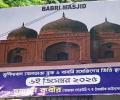
Union Home Minister Amit Shah addressed poll rallies in West Bengal, attacking Mamata Banerjee's TMC and promising development if the BJP wins the state elections. He accused Banerjee of appeasement politics and vowed to prevent the construction of a Babri Masjid-like structure in Bengal.

Tamil Nadu Chief Minister M K Stalin on Sunday admitted that 'as of now, some assurances such as getting NEET scrapped', could not be fulfilled.

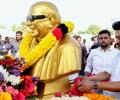
This article traces the history of the DMK's fight for state autonomy, beginning with C.N. Annadurai's advocacy in the 1960s and culminating in M. Karunanidhi's resolution in the Tamil Nadu Assembly in 1974. The article highlights the key figures involved, the arguments presented, and the impact of the Rajamannar Committee Report.
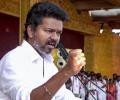
Vijay, who spoke on the fishermen issues in nearby Nagapattinam, sported a green headgear and addressed farmers' grievances and sought an answer from CM Stalin.

Shrug off the yoke of the imperialism of Delhi. That is why the DMK manifesto offers what it offers: The promise that Tamil Nadu will, one day, become an independent republic, notes Aditi Phadnis.

Vijay, with his chief ministerial ambitions, is a one-man army, at least as of now, and his campaign team considers him omnipresent. He has to be present in all districts, if not all constituencies at the same time, as there is no second-line leader or platform speaker in the party, who can draw crowds, points out N Sathiya Moorthy.

...the DMK chief minister's campaign -- which includes criticism of the BJP's 'pro-Hindutva, anti-Tamil, anti-federal' policies and building on his own government's social welfare programmes targeting especially women and youth -- appeals to Tamil Nadu's voters in next year's assembly election, explains N Sathiya Moorthy.
.jpg)
Asserting that Dravida Munnetra Kazhagam had the capability to face the polls with its existing local allies, party president M Karunanidhi on Tuesday said there was no setback for his Democratic Progressive Alliance in the absence of a national party in the combine.
Given the possibilities that next year's assembly elections could throw up, Stalin told the state assembly that an interim report had to be submitted by January 2026. The outcomes may well find its way into the DMK's poll manifesto, thus seeking to keep the electoral focus still on the BJP-ruled Centre and Prime Minister Modi, observes N Sathiya Moorthy.

However, Karunanidhi said he was not bothered even about his life and that democracy was important for him.

Stalin's sister and Rajya Sabha MP Kanimozhi will for the first time try her luck in the Lok Sabha.
EPS has had its way on most things, alliance-wise. A week earlier, he reiterated that he would not re-admit OPS and Sasikala Natarajan back in the party. It was a message not just to detractors in the AIADMK. It was even more so for the BJP leadership in Delhi. Even more important for the AIADMK was their demand for accepting EPS as the chief ministerial candidate of any alliance that the party would form, observes N Sathiya Moorthy.

The BJP has nothing to lose after a point. For the DMK it is a difficult choice, as it would not want to give too much of space to a 'national party' lest the 'Dravidian duel' of the past decades should be lost forever, observes N Sathiya Moorthy.

'What should surprise BJP supporters is Modi's call for 'stability' at the manifesto launch, a theme that he and his team members had not touched ahead of the Lok Sabha polls in 2014 and 2019.' 'The last time the party called for 'stability at the Centre' was in 1998 and 1999,' recalls N Sathiya Moorthy.

Denying rumours that he may opt out of the presidential race due to meagre support, Tharoor said he was very much in the fray and has been receiving support from various quarters.

Back of the envelope calculations put government expense on each of the new schemes promised by the DMK and the AIADMK at tens of thousands of crores. But then, neither party has said how they are going to also address the mounting debt burden either, says N Sathiya Moorthy.

Financial assistance of Rs 25,000 to one lakh persons going on pilgrimage to major Hindu temples, increase in maternity leave period and assistance, cut in fuel prices and steps to ban National Eligibility cum Entrance Test (NEET) were the various promises made by the Dravidian party.

Bettering the promise of monthly payouts to homemakers by the All India Anna Dravida Munnetra Kazhagam and the DMK, Kamal Haasan's Makkal Needhi Maiam on Friday assured Rs 3,000 "value rights assistance" to them in its manifesto for the April 6 assembly polls, but maintained it was not a dole.

It is increasingly clear that for the BJP to try and establish itself as an electoral force in Tamil Nadu, the party has to come out of the old Brahminical mould, observes N Sathiya Moorthy.
'The alliance led by the DMK is starting with 15% votes while the AIADMK is starting from scratch.' 'Minority votes may be crucial'
The DMK's campaign appeared to be the most visible with propaganda at a feverish pace across the segment for the April 6 assembly polls and Stalin is the party's chief minister candidate.
